Where conversations become transformation.
Every stage, classroom, boardroom and retreat becomes a space for meaningful dialogue. These are not performances — they are conversations that inspire lasting change.
Talks, podcasts and conversations.
Mastering the Mind with the Bhagavad Gita
The discussion explores how the Bhagavad Gita can provide practical guidance for navigating modern life, beginning with Aravindaksha Madhava Das Ji’s own journey from studying aeronautical engineering and working at Air India to becoming a full-time monk and teacher of the Gita. He explains that reading the Gita helped him find answers to questions about purpose, direction, and the “rat race” of life. A central message is that people may be highly capable and technologically advanced yet still lack clarity about where they are going. He emphasizes the importance of a teacher or mentor in understanding the Gita and applying its teachings practically rather than treating it merely as mythology or an abstract philosophical text.
A major part of the conversation focuses on duty, spirituality, and managing the mind and emotions. Aravindaksha explains the commonly misunderstood teaching that we have control over our actions but not over the final results. He describes several factors that influence outcomes and argues that recognising these factors can prevent unnecessary stress, self-blame, and frustration. He also distinguishes spirituality from merely performing rituals: the deeper purpose or “spirit” behind a practice is what makes it meaningful. The discussion then turns toward the need to care for the inner self or soul, just as we care for the body, and to make time for spiritual practices such as meditation.
The conversation also connects the Gita’s teachings with students, young people, relationships, and everyday challenges. Aravindaksha highlights the importance of guidance and a genuine mentor, comparing a spiritual teacher to a dedicated coach who helps someone achieve excellence. He discusses how young people can become overly focused on social media, external validation, and material achievement while neglecting their relationship with themselves. Ultimately, the discussion presents the Bhagavad Gita as a practical framework for developing clarity, purpose, discipline, self-awareness, and a deeper sense of fulfilment—not simply as an ancient religious text, but as a guide for living.
Manifest Anything: What the Bhagavad Gita Really Teaches
The video challenges the modern idea of “manifesting” or creating your own reality simply through thoughts and desires, and examines what the Bhagavad Gita actually teaches about this subject. The discussion explains that our circumstances and experiences are influenced by our actions and their consequences, and that we should not become overly attached to the results of our work. Instead of assuming that merely wanting something will make it happen, the Gita emphasizes understanding karma, duty, action, and responsibility. The transcript also distinguishes between different forms of action and explains that a person must be prepared to experience the consequences—whether positive or negative—of their actions.
A deeper theme of the discussion is that real transformation begins with consciousness and spiritual understanding, rather than simply trying to manipulate external circumstances. The speakers explain the importance of a genuine spiritual teacher or guru—someone whose consciousness is deeply grounded in spiritual knowledge—and discuss the relationship between the individual soul and God. The conversation ultimately presents the Gita’s approach as moving beyond material manifestation toward self-development, devotion, and aligning one’s life with Krishna and a higher purpose. In this perspective, material achievements have limited value on their own; they become meaningful when connected to spiritual consciousness and the right understanding of one’s relationship with the Divine.
A Path Towards Value-Based Living
In “A Path Towards Value-Based Living,” Shri Aravindaksha Madhava Das draws a parallel between the battlefield of Kurukshetra and the modern “battlefields” of classrooms, examinations, startups, and boardrooms. He presents Arjuna as a metaphor for today’s young professionals and students—capable and well-equipped, yet often struggling with confusion about what to do and what the world expects from them. Through the Bhagavad Gita, Krishna gives Arjuna clarity about his existence, purpose, and responsibilities. The talk emphasises that when confusion arises, we need clarity of thought, vision, and purpose, along with the guidance of a genuine guru or mentor.
The talk then connects Gita’s principles with value-based decision-making and leadership. Shri Aravindaksha explains the principle of putting duty above obsession with results and profit, illustrating it through examples such as Johnson & Johnson’s response to the Tylenol crisis and the collapse of Enron. He contrasts clarity and deliberate action with restlessness, anxiety, negligence, and excessive attachment to outcomes. He also highlights how leaders influence others through their actions, using the Tata Group as an example of leadership built on trust. Ultimately, the message is that modern professionals need more than skills and ambition—they need responsibility, stability, conscious decision-making, and clarity of purpose. The talk concludes with a powerful reflection: the next chapter of our lives may be less about what we achieve and more about who we become.
Fear of Death & the Eternal Journey of the Soul
The video explores the fear of death through the spiritual teachings of the Bhagavad Gita, particularly the distinction between the temporary physical body and the eternal soul. The discussion explains that birth and death are natural stages of the material body, but the soul itself exists beyond these physical changes. Shri Aravindaksha Madhava Das presents this as a fundamental shift in perspective: instead of identifying ourselves solely with the body, we should understand our deeper spiritual identity and recognise that something exists both before birth and after death.
The discussion further connects this understanding of the soul with how we should live our present life. Once Arjuna receives clarity about his existence, he also understands that he has responsibilities toward both the body and the soul. This leads to the Gita’s broader teaching of performing one’s duty without becoming excessively attached to results, profit, success, or failure. The message is ultimately not about ignoring life or death, but about gaining the clarity and spiritual wisdom needed to live responsibly and fearlessly. By understanding that the physical body is temporary while the soul continues beyond it, the Gita offers a different way of approaching mortality, purpose, and the journey of life.
Gen Z’s Problems — Breakups, Depression & Life Purpose
The discussion focuses on the challenges faced by Gen Z and how the Bhagavad Gita can provide direction, clarity, and a deeper sense of purpose. The speakers discuss how young people today can become confused by relationship problems, breakups, social-media-driven lifestyles, academic and career pressures, and the constant pursuit of external validation. Shri Arvindaksha Madhava Das explains that the Gita remains relevant because it addresses the same fundamental human confusion that Arjuna experienced. Rather than treating spirituality as something performed merely for social media or appearances, the conversation emphasizes genuine spiritual learning and the importance of receiving proper guidance.
A major message of the conversation is the importance of having the right direction and a genuine mentor or spiritual guide. Shri Arvindaksha explains that monks and teachers have a role in helping people who are otherwise capable but may lack clarity about where they should direct their lives. He describes the Gita as a source of wisdom that can help young people move from confusion toward clarity and understand their responsibilities, values, and purpose. The discussion also addresses broken relationships and the tendency among young people to feel that life is over after a failure or breakup, suggesting that spiritual wisdom can provide a broader perspective and help them respond to such experiences with greater maturity and balance.
Vedic Cosmology
The video “Vedic Cosmology | Aravindaksha Madhava Prabhuji | Prabhuji Ke Sath” explores the Vedic understanding of time, space, planets, the universe, and the structure of creation. Shri Aravindaksha Madhava Prabhuji introduces cosmology as a way of understanding how celestial bodies move and how the Vedic scriptures describe the universe. A significant part of the discussion focuses on developing a “reasonable faith” rather than accepting spiritual teachings blindly. He explains that Vedic knowledge should be examined with an open but thoughtful mind, because the scriptures present reasoning, causes, and principles behind their teachings.
The discussion then moves toward the Vedic conception of creation and the universe, contrasting modern scientific explanations with descriptions found in Vedic texts. Prabhuji encourages viewers to understand the deeper purpose behind spiritual practices and concepts rather than simply following rituals without knowing their meaning. The session presents Vedic cosmology not merely as information about planets and space, but as part of a broader spiritual framework that helps a person understand where we are, how the universe is structured, and ultimately where we are meant to go. The overall message is to approach Vedic knowledge with curiosity, reasoning, and a willingness to explore its deeper philosophical meaning.
Recent sessions and appearances.

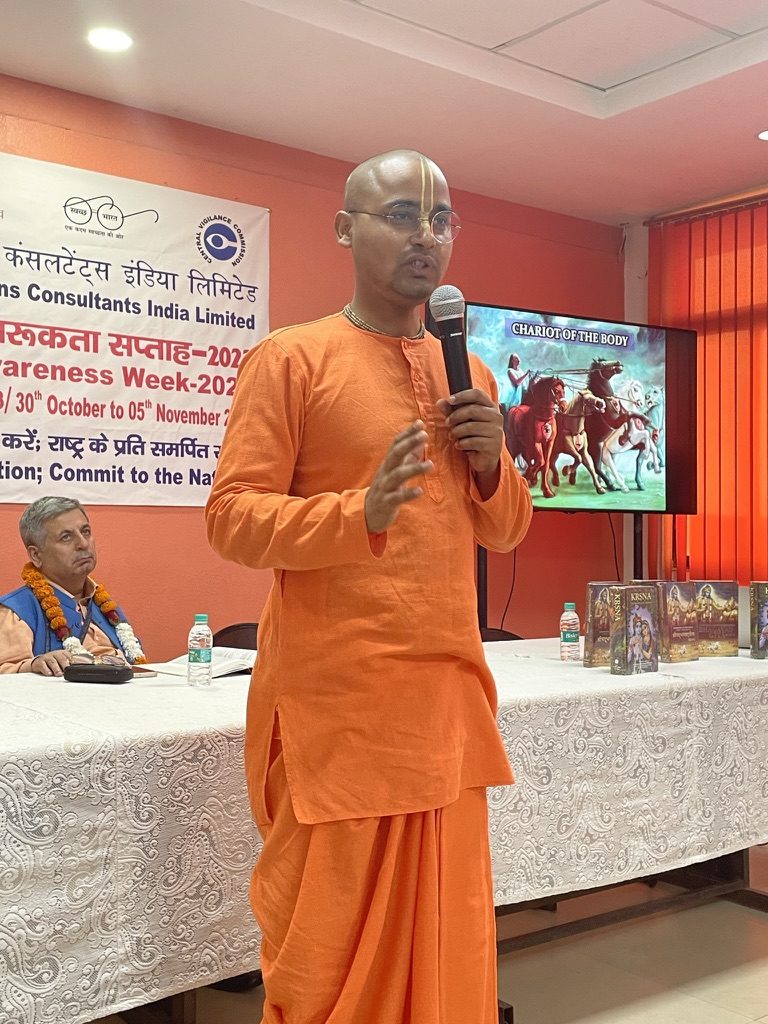
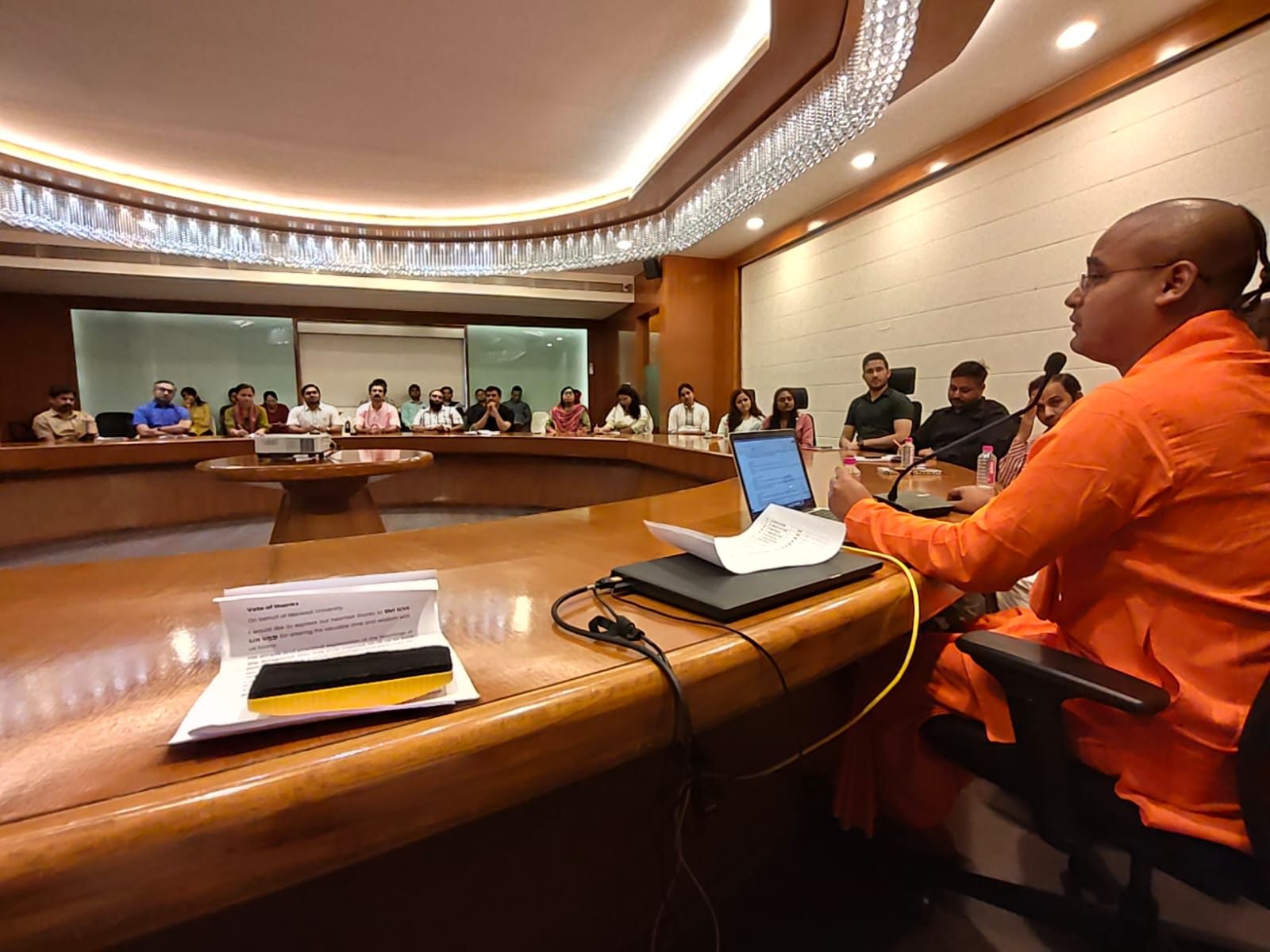
Gita for Professional Well-being
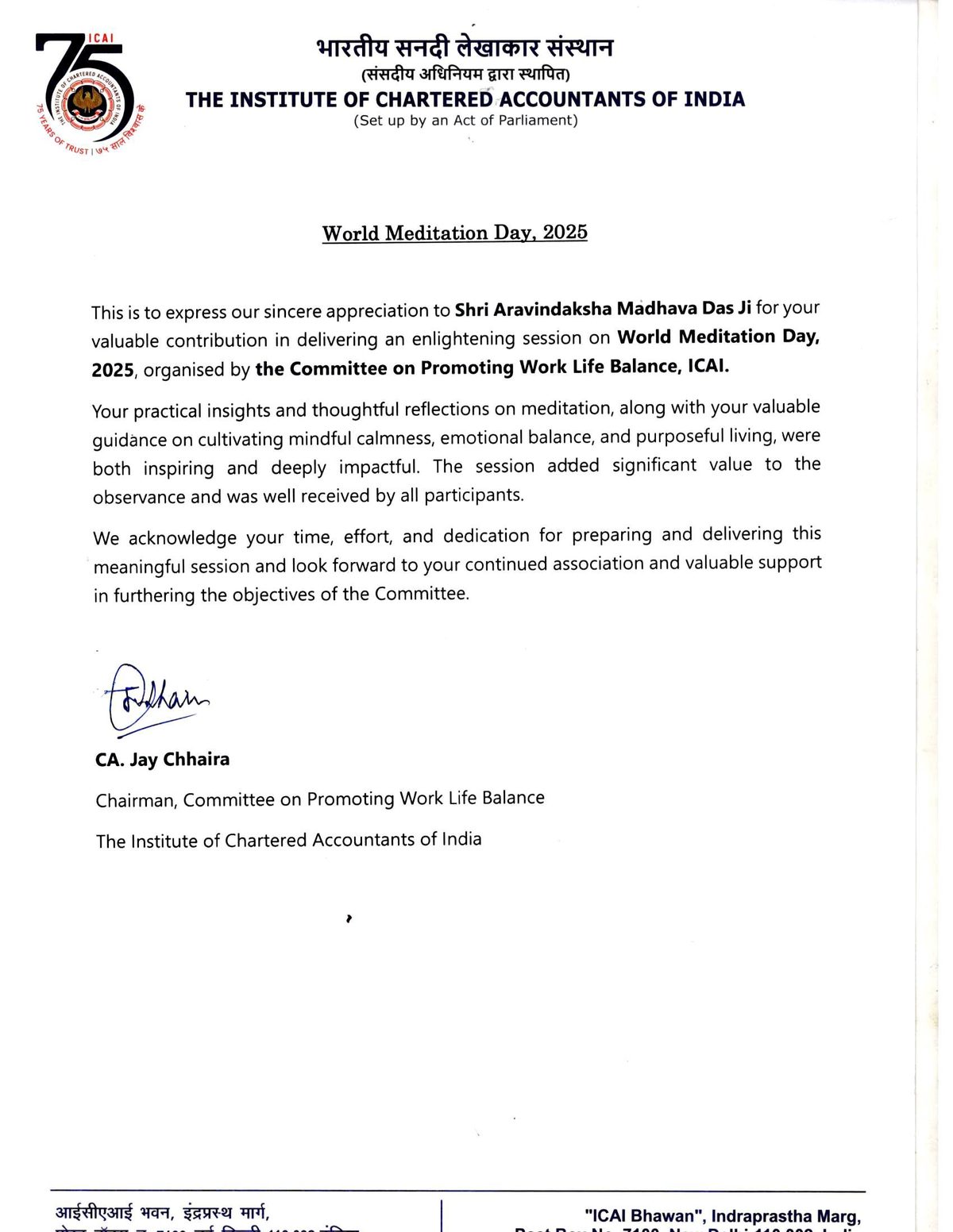
World Meditation Day 2025
Trusted by institutions, universities and Organisations.
Bring these conversations to your Organisation.
Whether it’s a university auditorium, leadership retreat, corporate gathering or youth forum, every conversation is thoughtfully designed to inspire clarity, purpose and meaningful action.